
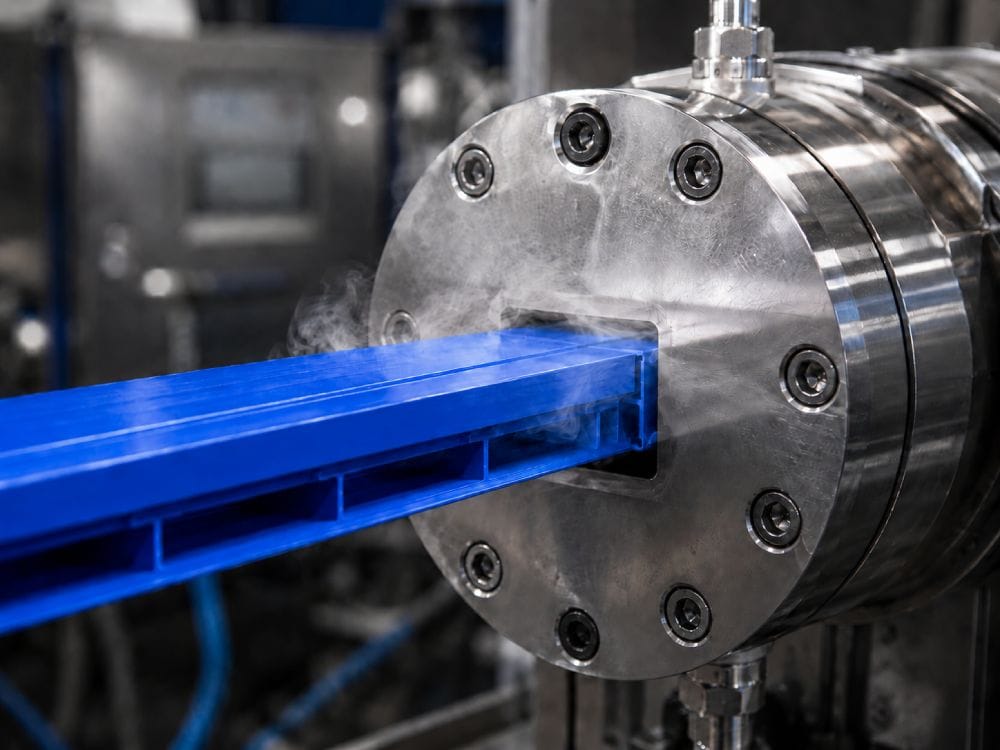
Plastic extrusion can turn raw thermoplastic material into a continuous profile, tube, rod, sheet, coating, or multi-material part. But the quality of the finished product does not come from the extruder alone. One of the most important pieces of the process is the plastic extrusion die.
The die is where molten plastic begins to take its final shape. It controls how the material flows, how evenly it is distributed, and how accurately the finished part matches the intended design. When the die is well designed, production can run more consistently, parts can hold their dimensions, and waste can be reduced. When the die is poorly designed, the entire process becomes harder to control.
For custom plastic extrusion projects, die design directly affects part quality, shape accuracy, surface finish, production speed, and long-term repeatability. Understanding how plastic extrusion dies work can help engineers, product designers, buyers, and manufacturers make better decisions before a part ever reaches production.
In this article, we’ll break down what plastic extrusion dies are, how they work, the different types of dies used in extrusion, and why die design is so important to quality and efficiency. We’ll also cover the key factors that influence die design and answer common questions about extrusion tooling.
What Are Plastic Extrusion Dies?
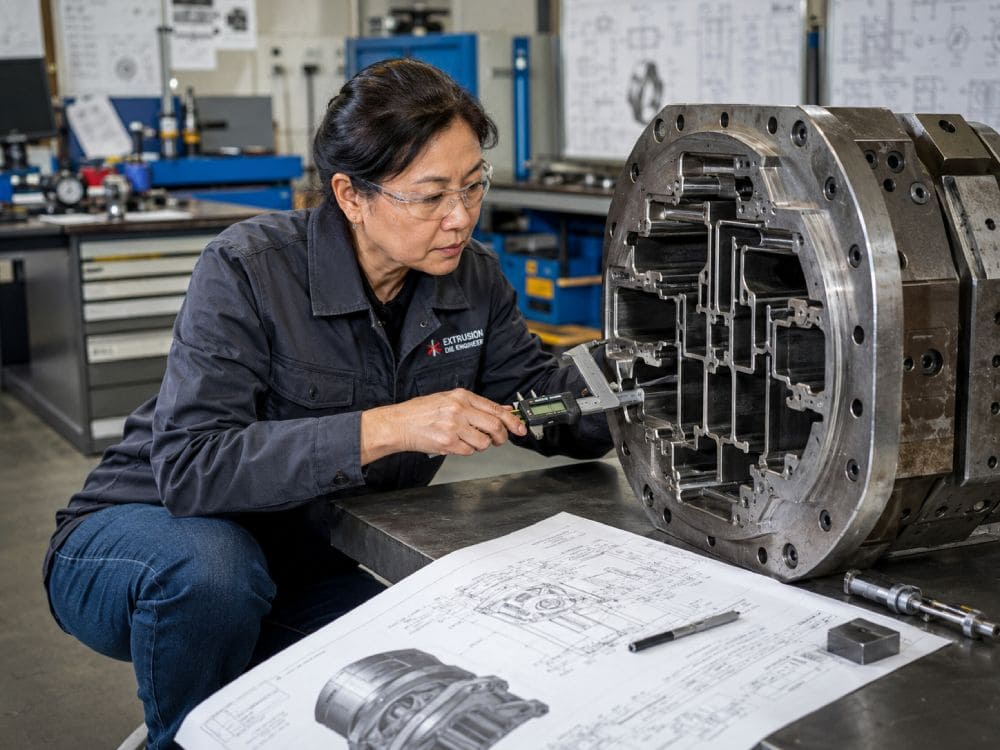
A plastic extrusion die is a precision tool mounted at the end of an extruder. Its job is to shape melted thermoplastic material as it exits the machine.
During extrusion, plastic resin is heated and pushed forward through the extruder barrel by a rotating screw. Once the material reaches the right temperature and pressure, it flows into the die. The die guides that molten plastic into the desired cross-sectional shape. From there, the material exits the die, moves through cooling and sizing equipment, and becomes a continuous finished or semi-finished plastic product.
A common mistake is assuming the die opening is simply a cutout of the final part shape. In reality, plastic extrusion die design is more complicated than that.
Plastic doesn’t behave like a rigid material when it leaves the die. It can expand, shrink, sag, twist, or change dimensions as it cools. Different plastics also respond differently to heat, pressure, cooling, and puller speed. Because of these characteristics, the die must be designed around both the desired part shape and the behavior of the material being processed.
How Plastic Extrusion Dies Work
Plastic extrusion dies work by controlling the path, pressure, and shape of molten plastic as it moves from the extruder into the finished product form. The basic idea is simple, but the details are important.
1. Plastic Resin Is Melted & Pressurized
The process begins when plastic pellets, powder, or compounds are fed into the extruder. Inside the barrel, heat and mechanical force melt the plastic into a consistent, workable material. The screw pushes the molten plastic forward under pressure.
At this stage, the plastic must be melted evenly. If the material is not properly heated, mixed, or pressurized, the die cannot correct every problem downstream.
2. Molten Plastic Enters the Die
Once the material reaches the die, it must flow into the tooling in a controlled way. The die’s internal channels guide the plastic and distribute it across the shape being formed.
Flow balance is critical here. If one area of the die receives more material than another, the final extrusion may have thick spots, thin spots, distortion, or inconsistent wall thickness.
3. The Die Shapes the Material
As the plastic moves through the die, the tool begins forming the material into the required profile, tube, sheet, coating, or layered structure.
This stage is where the design of the die opening and internal flow path becomes especially important. Complex profiles may include corners, ribs, hollow sections, flexible areas, rigid areas, or varying wall thicknesses. Each of these features changes how the plastic flows. The die must manage those differences so the final product comes out as stable and accurate as possible.
4. The Extrusion Exits the Die
When the material leaves the die, it’s still hot and flexible. The plastic may experience die swell, which means it expands after leaving the die. It may also shift, sag, or distort before it is fully cooled. The amount of change depends on the plastic material, the die design, the extrusion speed, the temperature, the puller tension, and the cooling setup.
A skilled tooling and extrusion team accounts for these variables during die design and process development.
5. Cooling & Sizing Lock in the Shape
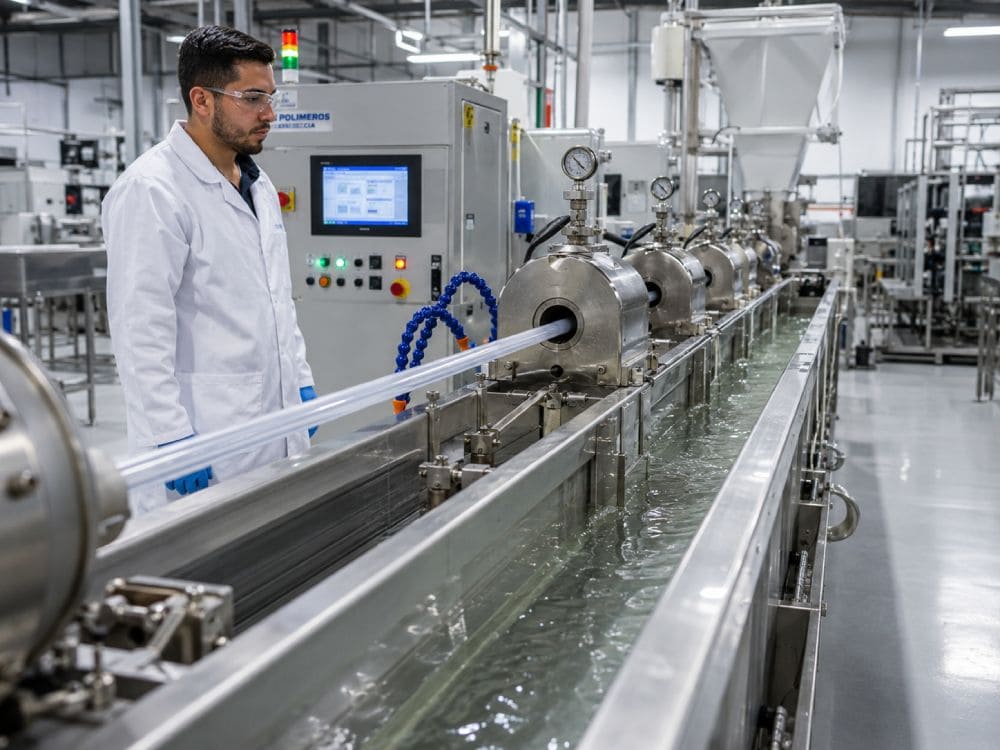
After leaving the die, the extrusion moves through cooling equipment. Depending on the part, it may also pass through sizing fixtures, vacuum calibrators, water tanks, air racks, or other equipment designed to help hold the final shape. This process helps the extrusion stabilize. The die creates the shape, but cooling and sizing help maintain it.
6. Downstream Equipment Finishes the Product
Once the extrusion is cooled and stabilized, it can be pulled, cut, punched, drilled, routed, printed, assembled, packaged, or fabricated further. For many custom plastic parts, these secondary operations are just as important as the extrusion itself.
Types of Plastic Extrusion Dies (Based on Output)
Plastic extrusion dies vary depending on what the final product needs to be. Some dies are built for simple solid shapes. Others are designed for complex profiles, hollow tubing, wide sheets, coated substrates, or multi-material parts.
Here are some of the most common types of plastic extrusion dies based on output.
Profile Dies
Profile dies are used to produce custom plastic profiles with a consistent cross-section. These may include channels, trims, gaskets, seals, spacers, lens covers, housings, connectors, display components, and other functional or decorative shapes.
In profile extrusion, the die must manage the geometry of the part. That can include thin walls, thick sections, sharp corners, soft edges, hollow areas, or features that need to fit with another component.
Profile die design is especially important because small dimensional issues can create big performance problems. A profile that twists, bows, shrinks unevenly, or has inconsistent wall thickness may not fit correctly in the final assembly. For custom plastic profiles, the die has to support both manufacturability and end-use performance.
Tubing Dies
Tubing dies create hollow plastic forms such as round, square, rectangular, or specialty tubes. These dies typically use internal tooling, such as a mandrel or pin, to form the inside diameter while the outer die controls the outside diameter.
Tubing dies must control several important dimensions at the same time, including inner diameter, outer diameter, wall thickness, roundness, and concentricity. If the material is not distributed evenly, the tube may have one wall that is thicker than the other, an off-center opening, or inconsistent shape from one section to the next.
For tubing used in assemblies, housings, protection, fluid movement, or structural applications, those differences can affect fit and function.
Rod Dies
Rod dies are used to produce solid plastic rods or similar continuous solid shapes. The die controls the outside diameter and helps guide the material into a stable form before cooling.
Although rods may seem simpler than profiles or tubing, they still require careful process control. Solid extrusions can be affected by cooling rates, internal stress, and dimensional drift. If the rod cools unevenly, it may warp or fail to hold the required tolerance.
The die, cooling method, material, and line speed all need to work together.
Flat & Sheet Dies
Flat and sheet dies are used to produce flat plastic sheets, strips, panels, or wide flat sections. These dies spread molten plastic across a wider opening.
The challenge is even distribution. The die must help the material flow from edge to edge while maintaining consistent thickness across the full width. Poor sheet die design can lead to uneven gauge, edge beading, warping, surface lines, or areas that are too thick or too thin. For parts that will be cut, formed, printed, or assembled later, those inconsistencies can create waste and quality problems.
Crosshead Dies
Crosshead dies are used when plastic needs to be extruded around another continuous material, which may include wire, cable, rope, chain, tubing, pipe, conduit, carbon fiber, stainless steel, dowels, or other substrates.
In this process, the substrate passes through the center of the die while molten plastic flows around it. The goal is to create a consistent coating or covering with the right thickness, coverage, and adhesion.
The coating needs to remain even around the substrate. If the plastic is not centered or distributed properly, the part may have thin coverage, weak spots, or inconsistent protection.
Co-Extrusion Dies
Co-extrusion dies are used to combine two plastic materials, colors, or properties into one finished extrusion. The two material streams are fed into the die and joined into a single continuous product.
This approach is useful when one part needs more than one function. For example, a profile might need a rigid section for structure and a flexible section for sealing. A product might need two colors for appearance, a soft skin over a rigid core, or a protective layer over a base material.
The die must control where each material goes and how the materials bond. That requires careful flow management, material compatibility, and temperature control.
Tri-Extrusion Dies
Tri-extrusion dies take the concept one step further by combining three materials, colors, layers, or functional zones into one extrusion. This process allows manufacturers to create more advanced designs, such as multi-color profiles, triple-layer tubing, rigid cores with flexible sides, textured gripping areas, or profiles that combine several performance characteristics in one part.
Tri-extrusion increases design possibilities, but it also increases complexity. Each material must flow correctly, bond properly, cool predictably, and maintain its position within the final profile. The die has to control all three streams without creating weak areas, visual inconsistencies, or dimensional instability.
Why Plastic Extrusion Dies Are Critical
The extrusion die has a direct impact on the quality and efficiency of the entire production process. A well-designed die can make production more stable. A poorly designed die can create problems that show up in every part that comes off the line.
Let’s explore why die design matters so much.
Plastic Extrusion Dies Control Final Shape & Dimensional Accuracy
The most obvious role of the die is to shape the plastic. But the real value is in shaping the material accurately after accounting for heat, pressure, swelling, shrinkage, cooling, and pulling.
A finished extrusion often needs to match a print, fit into another component, hold a tolerance, or perform in a specific environment. If the die does not account for how the plastic will behave, the final part may miss critical dimensions.
Even small dimensional changes can matter. A channel may not snap into place, and a seal may not compress properly. The tube may not fit with a mating part, and the profile may not align with the rest of an assembly. Good die design reduces those risks early.
Plastic Extrusion Dies Improve Consistency Across Production Runs
Manufacturers don’t just need one good part. They need the same part produced repeatedly.
Consistency is one of the biggest reasons die design matters. A stable die helps maintain the same dimensions, wall thickness, surface finish, and overall shape across long production runs. It also supports repeat orders by making the process easier to reproduce later. For customers, that consistency can mean fewer inspection issues, fewer assembly problems, and more predictable product performance.
Plastic Extrusion Dies Help Reduce Scrap & Rework
When a die creates uneven flow or unstable dimensions, scrap rates can climb quickly. Parts may need to be rejected, trimmed, reworked, or rerun, which wastes material, labor, machine time, and money.
Better die design can reduce the amount of trial and error required during production. It can also help operators make adjustments more efficiently when needed.
Plastic Extrusion Dies Support Production Efficiency
A part that looks good at slow speed is not always ready for efficient production. For commercial manufacturing, the die must support stable output at a practical production rate.
A well-designed die can help improve line speed, reduce setup time, shorten troubleshooting cycles, and keep production running more predictably. It can also make it easier to maintain quality without constant intervention.
Plastic Extrusion Dies Affect Surface Finish & Appearance
For visible plastic parts, surface finish matters. Customers may care about gloss, texture, clarity, color consistency, smoothness, or the absence of lines and defects.
The die can influence how the surface appears as the plastic exits the tooling. Flow marks, streaks, roughness, or uneven material distribution may all trace back to tooling or process issues. It’s especially important for consumer products, lighting components, display parts, signage, trim, decorative profiles, and any extrusion that remains visible in the final application.
Plastic Extrusion Dies Help Manage Complex Materials & Multi-Material Designs
Different thermoplastics have different processing characteristics. Some flow easily, while others are more rigid or shrink more than others.
Die design becomes even more important when working with multiple materials, colors, additives, recycled content, or performance requirements. In co-extrusion and tri-extrusion, the die must manage separate material streams while maintaining bond strength, shape stability, and clean material placement. The more complex the part, the more important the die becomes.
Plastic Extrusion Dies Influence Long-Term Tooling Value
A well-designed extrusion die can support repeatable production over time. It may also allow for adjustments, refinements, and future production runs without starting the process over from the beginning. For customers who expect ongoing orders, product line extensions, or future design improvements, the die becomes part of the long-term manufacturing strategy.
Common Factors That Influence Plastic Extrusion Die Design
Every extrusion project has its own requirements. A die that works well for one part may not work for another. Several factors influence how the tooling should be designed.
Part Geometry
The shape of the part is one of the biggest factors. A design that looks good on paper may need to be adjusted so it can be extruded consistently. Simple shapes are usually easier to tool and produce. Complex profiles with hollow areas, thin walls, thick sections, sharp corners, flexible features, or multiple cavities require more planning.
Material Selection
The die must be designed with the selected material in mind. Material choice affects flow, shrinkage, cooling, flexibility, strength, surface finish, and cost. PVC, ABS, polyethylene, polypropylene, polycarbonate, acrylic, nylon, thermoplastic elastomers, and other materials all behave differently in the extrusion process.
Wall Thickness
Wall thickness affects flow balance, cooling, strength, weight, and stability. Uneven wall thickness can lead to warping, sink marks, weak areas, or inconsistent dimensions. When possible, part designs should avoid unnecessary thickness changes that make extrusion harder to control.
Tolerances
Tight tolerances require more than a good drawing. They require the right die design, material choice, process setup, cooling method, sizing equipment, and inspection plan. The tighter the tolerance, the more important the full extrusion process becomes.
End-Use Environment
The die and material strategy should support how and where the part will be used. For example, a part used outdoors may need UV resistance, while a refrigeration component may need low-temperature performance.
Production Volume
Production goals should be discussed early so the tooling strategy matches the business need. A prototype run and a high-volume production run may require different tooling strategies. A short run may prioritize speed and flexibility, and a long-term production program requires tooling built for repeatability, durability, efficiency, and future modifications.
Secondary Fabrication
Many extrusions require additional work after they leave the line. They may be cut, drilled, routed, punched, printed, assembled, or packaged in a specific way. Those secondary operations should be considered during design. A part that extrudes well but is difficult to fabricate may still create unnecessary cost or delays.
FAQs About Plastic Extrusion Dies
What Is a Plastic Extrusion Die?
A plastic extrusion die shapes molten plastic into a continuous product as it exits the extruder. Depending on the die, it may produce a profile, tube, rod, sheet, coating, or multi-material extrusion.
Is the Die Opening the Same Shape as the Finished Part?
Not always. The die opening may need to be different from the final part shape because plastic can expand, shrink, cool, and move after it exits the die. Tooling designers account for these changes when creating the die.
Why Is Die Design So Important in Plastic Extrusion?
Die design affects dimensional accuracy, wall thickness, surface finish, production speed, scrap rates, and consistency across production runs. A better die can make the full extrusion process more stable and efficient.
What Materials Can Be Used with Plastic Extrusion Dies?
Many thermoplastics can be processed through extrusion dies, including polyvinyl chloride (PVC), acrylonitrile butadiene styrene (ABS), polyethylene, polypropylene, polycarbonate, acrylic, nylon, thermoplastic elastomers, and other materials depending on the application.
What Is the Difference Between Profile Extrusion & Tubing Extrusion Dies?
Profile dies create custom shapes with a consistent cross-section. Tubing dies create hollow shapes and must control both the inside and outside dimensions of the tube.
What Is a Co-Extrusion Die?
A co-extrusion die combines two material streams into one finished extrusion. It can be used for dual-color parts, rigid and flexible combinations, layered parts, seals, hinges, and other multi-function profiles.
What Is a Tri-Extrusion Die?
A tri-extrusion die combines three materials, colors, or functional zones into one finished extrusion. It’s often used for more complex profiles that need several performance characteristics in a single part.
Can Plastic Extrusion Dies Be Modified?
In many cases, extrusion dies can be adjusted or modified to improve flow, dimensions, surface finish, or production performance. The amount of flexibility depends on the die design, part geometry, material, and required change.
How Long Does It Take to Create a Plastic Extrusion Die?
Timing depends on the complexity of the part, material selection, tolerance requirements, tooling workload, and whether the project needs prototyping, testing, or revisions before production.
Why Work with a Manufacturer That Has In-House Tooling?
In-house tooling can improve communication between engineering and production. It can also support faster changes, better process control, and a smoother path from design to finished extrusion.
Contact Lakeland Plastics: The Leading Plastic Extrusion Company
Plastic extrusion dies play a major role in the success of a custom extrusion project. They shape the material, guide the flow, support dimensional accuracy, and influence how efficiently the part can be produced.
At Lakeland Plastics, we work with customers on custom plastic extrusion projects that require thoughtful design, reliable tooling, consistent production, and practical support from concept through completion. With capabilities that include custom profile extrusion, rod and tube extrusion, crosshead coating, co-extrusion, tri-extrusion, design engineering, in-house tooling, 3D printing, fabrication, and assembly, our team can help turn complex plastic part ideas into manufacturable solutions.
Contact us or request a quote today to discuss your project and discover how our expertise can move your vision forward.